
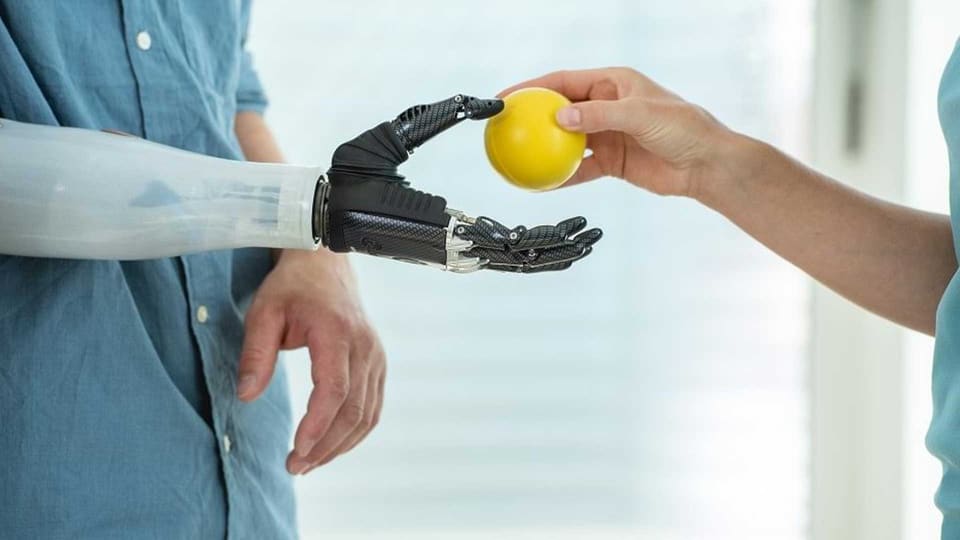
Below-elbow (transradial) prostheses – prosthetic hands
Prosthetic hands for below-elbow amputation: functional myoelectric or body-powered prostheses and cosmetic solutions, with multi-articulating hands such as the bebionic and i-Limb Quantum.
Above-elbow prostheses for amputation above the elbow: cosmetic, body-powered and myoelectric solutions, with electronic elbows and a design tailored to you.
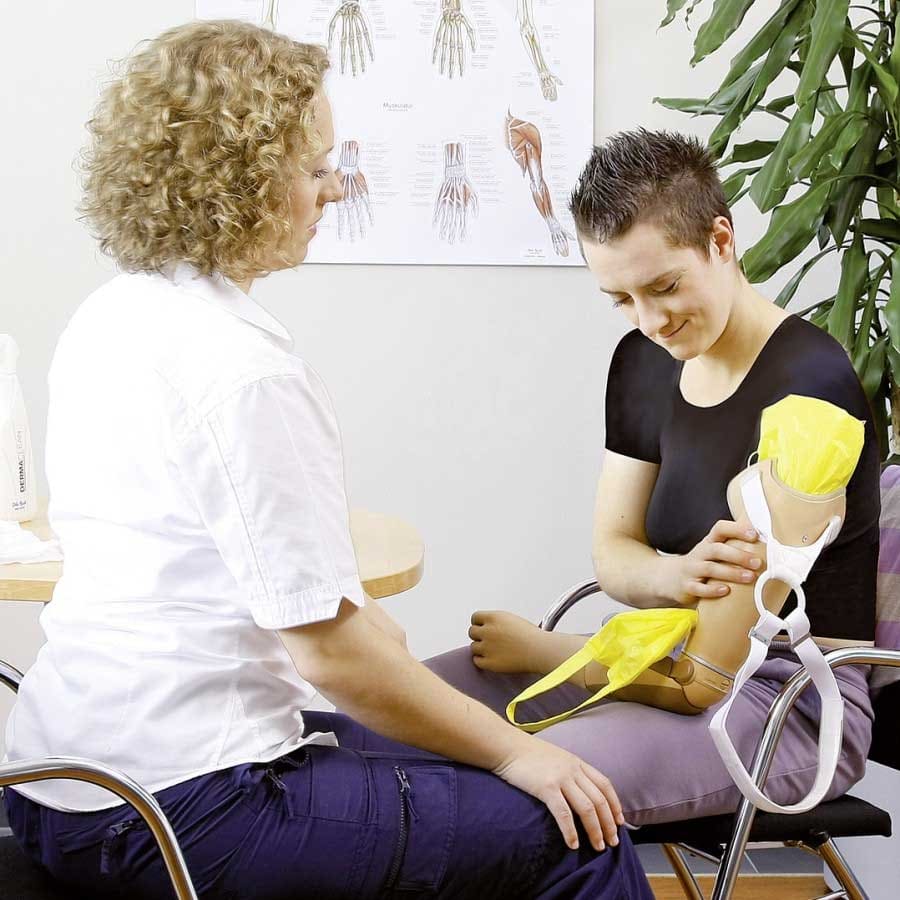
Amputation of the arm above the elbow (transhumeral amputation) is usually the result of an injury and, less often, of a tumour or another medical cause. Functional rehabilitation is clearly more difficult than in the lower limbs, because the prosthesis has to replace the hand, the wrist and the elbow at the same time.
Modern prosthetic arms, and myoelectric above-elbow prostheses in particular, now offer far more possibilities than they did just a few years ago. At Hlamidis Orthopaedic Center in Thessaloniki we custom-design every upper-limb prosthesis, drawing on our experience since 1952.
It has no active movement, but it looks natural and is lightweight. It helps with body symmetry and can be used as a support in simple everyday tasks.
It is moved by the strength of your own body: with movements of your shoulder and shoulder blade, a cable attached to a harness opens and closes the hand or terminal device and locks the elbow. It is durable and reliable, especially for manual work.
This is what most people call a “bionic” or electronic prosthetic arm. Electrodes in the socket detect the electrical signals of the muscles in your residual limb when they contract, and a battery powers the motors of the hand, the wrist and, in above-elbow prostheses, the elbow. You will find more detail on how myoelectric hands work on our page on below-elbow prostheses.
In myoelectric above-elbow prostheses the elbow plays a decisive role. The Ottobock DynamicArm is an electronic elbow driven by an electric motor and controlled by muscle signals, for users with an amputation at upper-arm level or higher. According to the manufacturer, it offers high lifting and holding strength, precise elbow positioning and a natural, silent free swing when walking.
The elbow is combined with a myoelectric hand, such as the Ottobock bebionic multi-articulating hand, and with an electric wrist rotator, depending on your needs. You can read more about multi-articulating hands on our page on below-elbow prostheses.
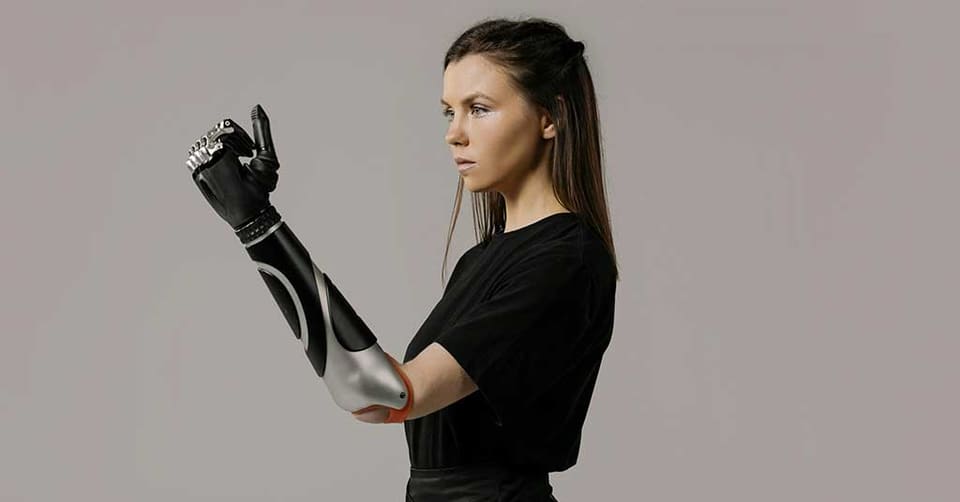
No prosthetic arm fully replaces a natural one. With the right choice, a good socket and training, however, many users regain a significant degree of independence.
The type of prosthesis is chosen by you and our prosthetist, in collaboration with your treating physician. We take into account:
The success of a myoelectric prosthesis depends heavily on training. We work with physiotherapists and occupational therapists so that you learn to control your prosthesis in real-life conditions.
The cost of an above-elbow prosthesis varies widely between a cosmetic, a mechanical and a myoelectric solution. After your assessment, we give you a written proposal with a breakdown per component.
Is it covered by EOPYY? We are a contracted provider of EOPYY (ΕΟΠΥΥ), Greece’s national health insurance organisation, whose reimbursement applies to people insured in Greece. As an indication, the maximum reimbursable price according to Government Gazette (ΦΕΚ) B' 1079/2022 is €2,250 for the electronic elbow of an electric prosthesis, €850 for an external upper-arm socket for an electric prosthesis, €1,788 for a simple electric hand, €785 for electrodes and €420 for lithium batteries (every 3 years). You need an electronic prescription/referral from a doctor of the relevant specialty, and the co-payment is 25% (Government Gazette B' 2106/2025, article 46). If your prosthesis costs more, contact us so that we can check what applies in your case. See our page on EOPYY reimbursement. If you are not insured in Greece, EOPYY reimbursement does not apply; you can pay privately, and any cover depends on your own insurer’s rules – contact us and we will give you the information you need for your case. This information is valid as of the date of the last update.
See all our solutions in upper-limb prosthetics, the shoulder disarticulation prosthesis for higher amputations, or book an appointment on +30 2310 282 894.
Electrodes inside the socket detect the electrical signals produced by the muscles of your residual limb when they contract. These signals are translated into movements of the hand, wrist or elbow, while a rechargeable battery provides the power. With training, control becomes more and more natural.
The cost varies considerably: a cosmetic prosthesis costs much less than a myoelectric one with an electronic elbow and a multi-articulating hand. After your assessment, we give you a written proposal per component and calculate the EOPYY reimbursement if you are insured in Greece. Contact us so that we can look at your case, or see our page on EOPYY reimbursement.
Most myoelectric prostheses contain electronics and batteries and must not be immersed in water. Some components can withstand splashes, but water resistance differs by manufacturer and model. When we hand over your prosthesis, we give you the manufacturer’s instructions for your specific prosthesis and for looking after it day to day.
It depends on the type of prosthesis, your residual limb and your experience. Myoelectric above-elbow prostheses usually need more practice, because you control more joints: elbow, wrist and hand. We work with physiotherapists and occupational therapists so that training happens step by step and with real everyday tasks.
An above-elbow prosthesis is for amputation above the elbow and also has to replace the elbow. A below-elbow prosthesis is for amputation below the elbow, where your natural elbow is preserved, so the prosthesis is usually simpler and lighter. See our below-elbow prostheses.
Prosthetic hands for below-elbow amputation: functional myoelectric or body-powered prostheses and cosmetic solutions, with multi-articulating hands such as the bebionic and i-Limb Quantum.
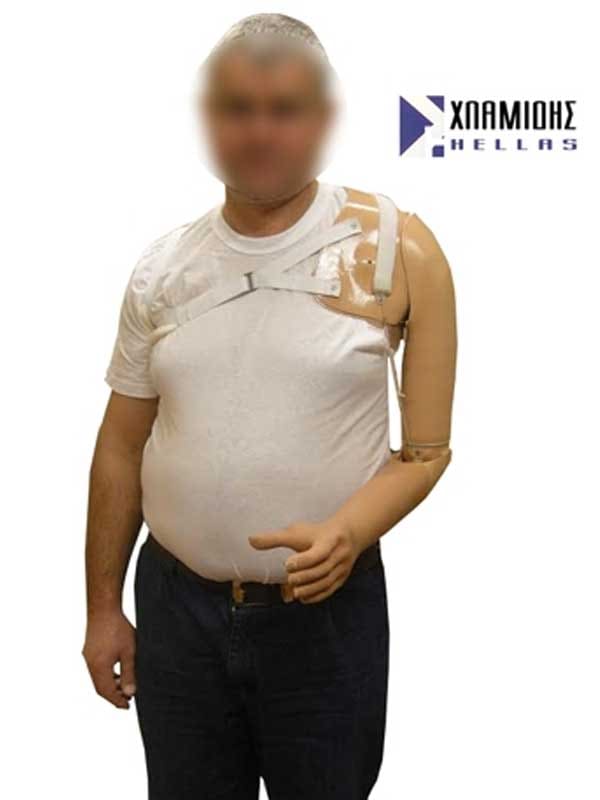
Even when almost the entire arm has been removed, a shoulder disarticulation prosthesis can provide symmetry, support and, with myoelectric components, function.









Book an assessment at Egnatia 101, Thessaloniki, or call +30 2310 282 894 about an above-elbow prosthesis.
Settings are saved on your device. Accessibility statement