
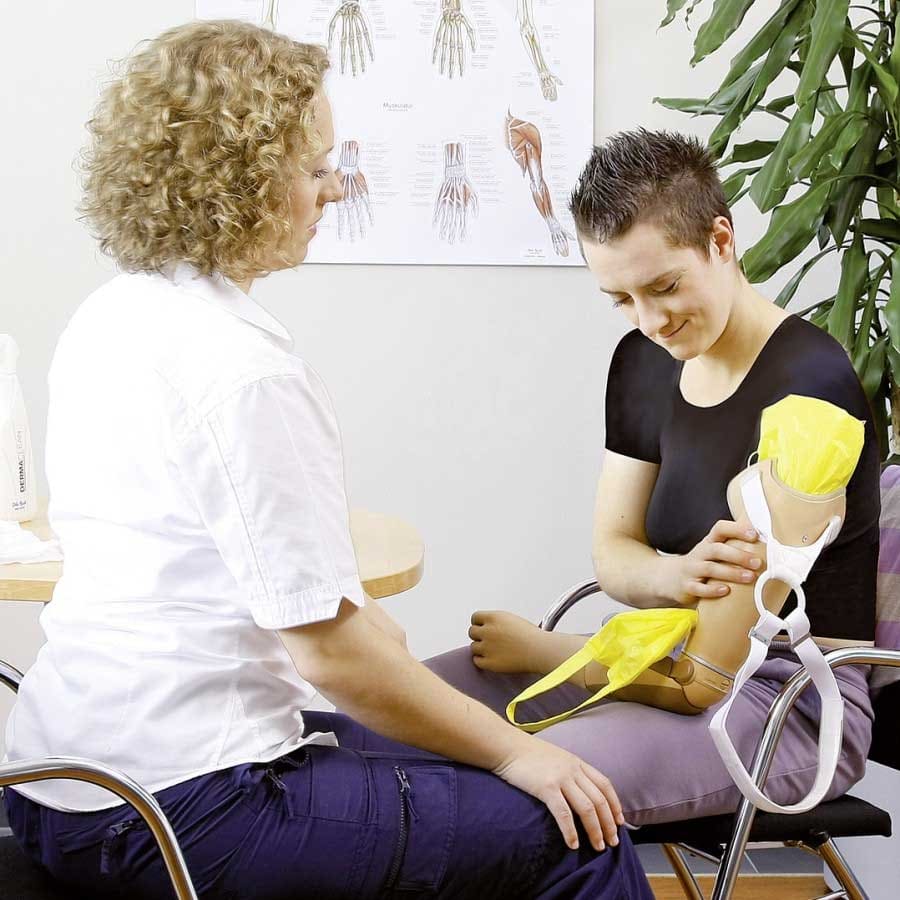
Prosthetic arms – above-elbow (transhumeral) prostheses
Above-elbow prostheses for amputation above the elbow: cosmetic, body-powered and myoelectric solutions, with electronic elbows and a design tailored to you.
Even when almost the entire arm has been removed, a shoulder disarticulation prosthesis can provide symmetry, support and, with myoelectric components, function.
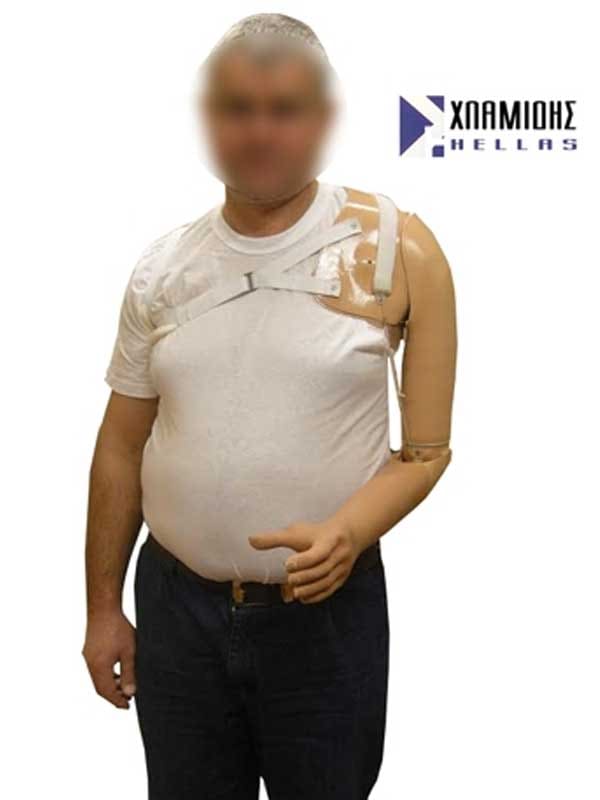
Shoulder disarticulation is an amputation at the level of the shoulder joint, where almost the entire arm has been removed. In even more extensive cases, part of the shoulder blade or collarbone may also have been removed. It is one of the most demanding levels for prosthetics, because the prosthesis has to replace the shoulder, elbow, wrist and hand.
Even in these cases there are solutions. Thanks to advances in technology, our experience since 1952 and our collaboration with leading manufacturers such as Ottobock and Össur, at Hlamidis Orthopaedic Center we can offer prostheses that provide a significant degree of independence and function.
A prosthesis is not only about hand function. Losing the entire arm changes the balance and posture of your body. A prosthesis can help with:
A lightweight prosthesis with a natural appearance, often with joints that you adjust with your other hand. It restores symmetry and can be used as a support in simple tasks.
It is operated by movements of your trunk and of the shoulder on the other side, via straps and a cable. At this level it requires a fair amount of strength and practice.
It uses muscle signals from the chest, back or shoulder muscles to move electric components, such as an electronic elbow, a wrist rotator and a myoelectric hand. Electric and body-powered components are often combined. For the Ottobock DynamicArm electronic elbow and myoelectric hands, see our above-elbow prostheses and below-elbow prostheses.
At this level, the socket fits over the shoulder and chest and is usually held in place with straps. It must be stable, so that the prosthesis does not shift, but also as light and well ventilated as possible, so that you can wear it comfortably all day. That is why we carry out fitting trials before the final prosthesis is made.
To learn more about control with muscle signals, see how myoelectric hands work on our below-elbow prostheses page.
Life changes after such a high amputation, and adjusting takes time. Many everyday tasks can be done again with one hand, with the help of the prosthesis and small changes at home and at work. Psychological support is just as important as technology. In our guide after amputation you will find the steps leading up to your first prosthesis.
The cost varies widely between a cosmetic, a body-powered and a myoelectric prosthesis. After your assessment, we give you a written proposal with a breakdown per component.
Is it covered by EOPYY? We are a contracted provider of EOPYY (ΕΟΠΥΥ), Greece’s national health insurance organisation, whose reimbursement applies to people insured in Greece. Upper-limb prosthesis components are reimbursed up to the maximum prices in Government Gazette (ΦΕΚ) B' 1079/2022 (e.g. €2,250 for an electronic elbow for an electric prosthesis), with an electronic prescription/referral from a doctor of the relevant specialty and a 25% co-payment (Government Gazette B' 2106/2025, article 46). For a shoulder disarticulation prosthesis, contact us so that we can check what applies in your case. See our page on EOPYY reimbursement. If you are not insured in Greece, EOPYY reimbursement does not apply; you can pay privately, and any cover depends on your own insurer’s rules – contact us and we will give you the information you need for your case. This information is valid as of the date of the last update.
See all our solutions in upper-limb prosthetics or book an appointment on +30 2310 282 894.
It is an amputation at the level of the shoulder joint, in which the whole upper arm and the rest of the arm are removed. In more extensive operations, part of the shoulder blade or collarbone may also be removed. At this level, the prosthesis has to replace the shoulder, elbow, wrist and hand.
In many cases, yes, provided there are suitable muscle signals, for example from the chest or back muscles. Electric and body-powered components are often combined. Whether you are a candidate is decided after an assessment, in collaboration with your treating physician.
A complete shoulder prosthesis with electric components has a noticeable weight, which is why the socket and straps are designed to spread the load correctly across your trunk. Cosmetic prostheses are much lighter. We discuss the balance between function and weight with you before choosing the components.
For people insured in Greece, upper-limb prosthesis components are reimbursed up to the maximum prices in Government Gazette (ΦΕΚ) B' 1079/2022, with a prescription from a doctor of the relevant specialty and a 25% co-payment. Because every shoulder prosthesis is different, contact us so that we can check what applies in your case. See our page on EOPYY reimbursement.
Above-elbow prostheses for amputation above the elbow: cosmetic, body-powered and myoelectric solutions, with electronic elbows and a design tailored to you.

Prosthetic hands for below-elbow amputation: functional myoelectric or body-powered prostheses and cosmetic solutions, with multi-articulating hands such as the bebionic and i-Limb Quantum.









Book an assessment at Egnatia 101, Thessaloniki, or call +30 2310 282 894.
Settings are saved on your device. Accessibility statement