
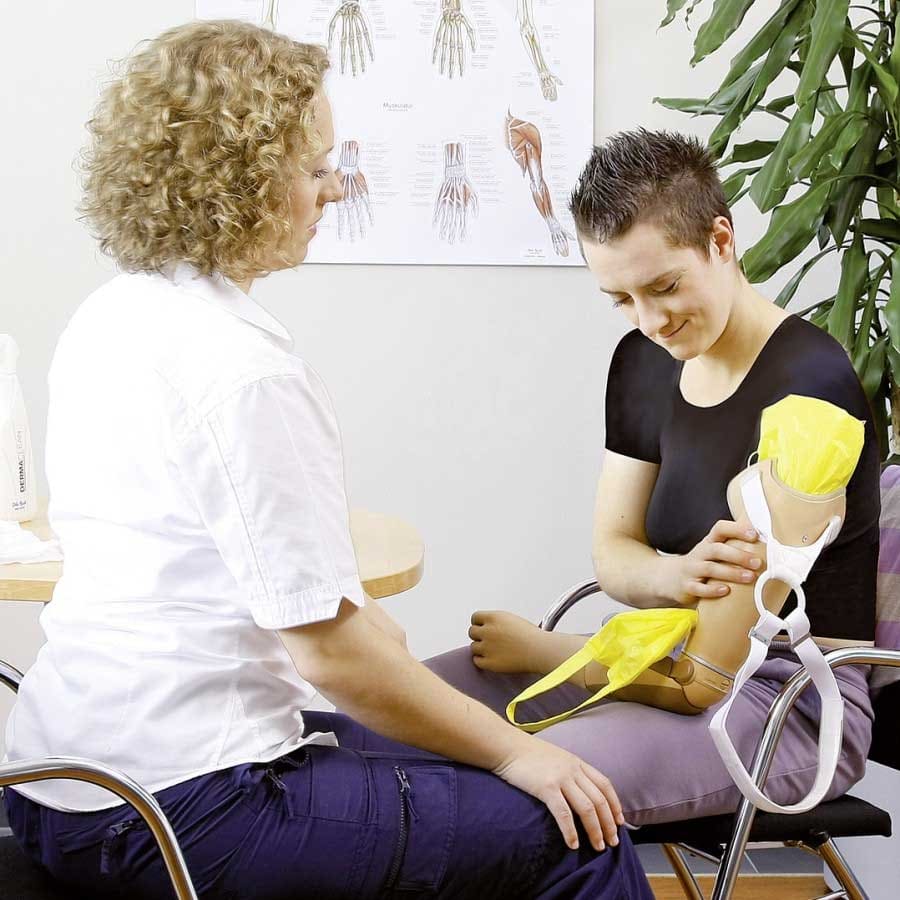
Prosthetic arms – above-elbow (transhumeral) prostheses
Above-elbow prostheses for amputation above the elbow: cosmetic, body-powered and myoelectric solutions, with electronic elbows and a design tailored to you.
Prosthetic hands for below-elbow amputation: functional myoelectric or body-powered prostheses and cosmetic solutions, with multi-articulating hands such as the bebionic and i-Limb Quantum.
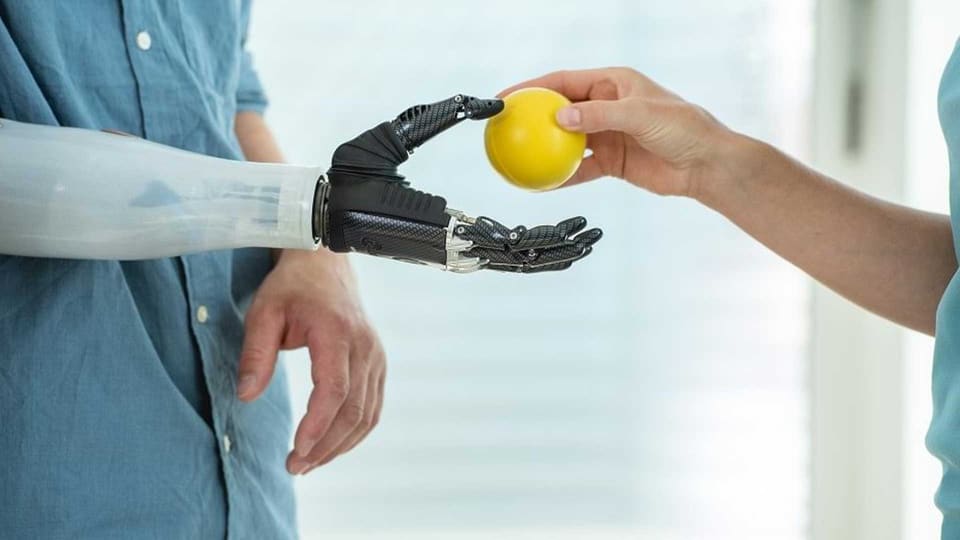
Below-elbow (transradial) amputations, in other words amputations of the forearm, are the most common type of upper-limb amputation. They can take place at different levels, from just below the elbow down to the wrist. The most common causes are injuries, infections, vascular disease and tumours.
Because your natural elbow is preserved, a below-elbow prosthesis is usually simpler than an above-elbow prosthesis, which also has to replace the elbow. Its aim is to restore as much of the lost function as possible.
Coming to terms with the amputation and adapting to the prosthetic limb are just as important as the technology. The best results come from teamwork across several specialties: early fitting of the prosthesis for a quick return to everyday life, psychological support, physiotherapy and occupational therapy.
The choice is made by you and our prosthetist, in collaboration with your treating physician.
It has no active movement, but it is made to look like a real hand, with an appearance and feel close to that of skin. For amputations at the level of the palm or fingers, see our silicone hand prostheses.
The bebionic is a multi-articulating myoelectric hand with a separate motor in each finger. According to Ottobock, it offers 14 different grip patterns and hand positions for everyday tasks such as eating, tying shoelaces, carrying a bag, opening a door and typing. Proportional control lets you adjust speed and force: gentler muscle signals give slower movement and a softer grip, while stronger ones give faster, firmer movement.
The i-Limb Quantum is a multi-articulating myoelectric hand from Össur with five independently moving fingers and an electrically rotating thumb. According to the manufacturer:

For people who have lost from one up to five fingers while keeping the palm, there is the Össur i-Digits Quantum. It is a myoelectric partial-hand prosthesis with independently moving fingers that work together with any fingers you still have. It offers up to 32 grips and gesture control, while the batteries and microprocessor are housed in a separate wrist unit.
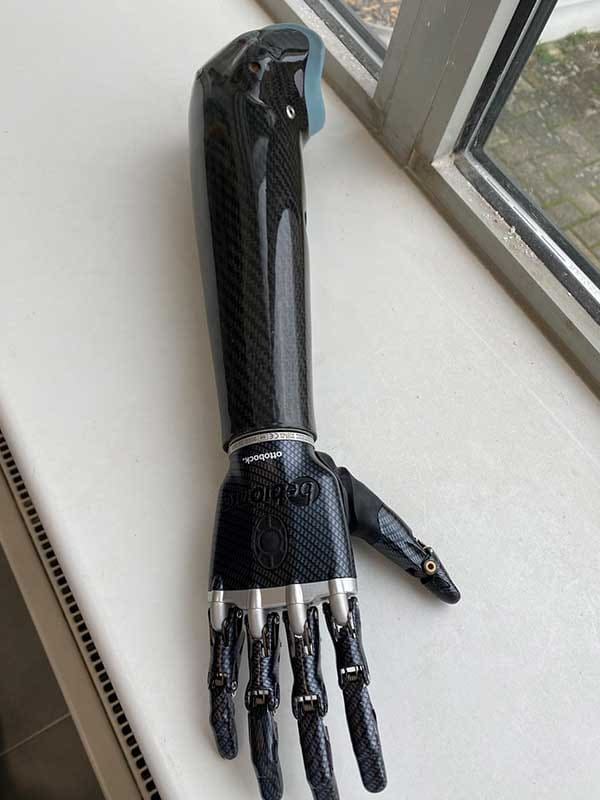
To learn more about the technology behind these prostheses, see our page on bionic technology in prosthetics.
Is it covered by EOPYY? We are a contracted provider of EOPYY (ΕΟΠΥΥ), Greece’s national health insurance organisation, whose reimbursement applies to people insured in Greece. As an indication, the maximum reimbursable price according to Government Gazette (ΦΕΚ) B' 1079/2022 is €1,788 for a simple electric hand, €2,180 for one with adjustable sensitivity and €3,065 for an electric hand with sensors; for a below-elbow socket for an electric prosthesis it is €513 (inner) and €850 (outer). You need an electronic prescription/referral from a doctor of the relevant specialty, and the co-payment is 25% (Government Gazette B' 2106/2025, article 46). Multi-articulating hands usually cost more than the maximum amounts; contact us so that we can check what applies in your case. See our page on EOPYY reimbursement. If you are not insured in Greece, EOPYY reimbursement does not apply; you can pay privately, and any cover depends on your own insurer’s rules – contact us and we will give you the information you need for your case. This information is valid as of the date of the last update.
See all our solutions in upper-limb prosthetics or book an appointment on +30 2310 282 894.
Both are high-tech multi-articulating myoelectric hands, with differences in how you switch grips, the grips available and the settings. There is no single “best” hand for everyone: the choice depends on your residual limb, your muscle signals, the weight you can carry comfortably and the tasks you want to do. We decide together after an assessment.
A multi-articulating myoelectric hand costs considerably more than a body-powered or cosmetic prosthesis, and the final amount depends on the hand, the socket, the wrist and the electrodes. After your assessment, we give you a written proposal and calculate the EOPYY reimbursement if you are insured in Greece. See our page on EOPYY reimbursement.
Yes. For partial hand loss, from one to five fingers with the palm preserved, there is the Össur i-Digits Quantum, with independently moving fingers that work together with the fingers you still have. If you prefer a cosmetic solution, see our silicone hand and finger prostheses.
It is heavier than a cosmetic or body-powered prosthesis, because it contains motors and a battery. How heavy it feels depends a lot on the socket and the length of your residual limb: a well-designed socket spreads the load so that you can wear it comfortably all day. You will try the fit before the final prosthesis is made.
Myoelectric prostheses run on rechargeable batteries, and most users charge them every night, just like a mobile phone. Battery life depends on the model and on how you use it. EOPYY provides for replacement of lithium batteries every 3 years. We will give you instructions on correct charging and care.
Above-elbow prostheses for amputation above the elbow: cosmetic, body-powered and myoelectric solutions, with electronic elbows and a design tailored to you.
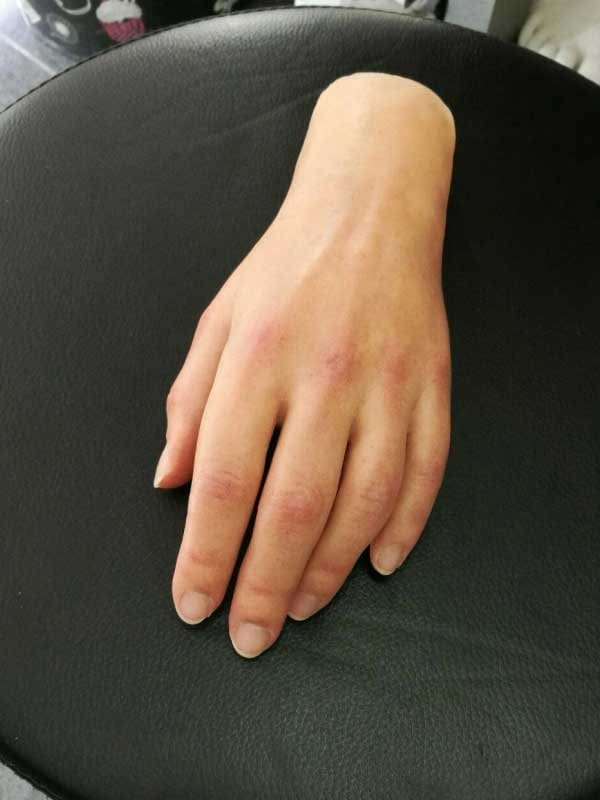
Custom-made silicone prosthetic fingers and partial hand prostheses, with the shape, detail and skin tone of your own hand, for a natural appearance and greater confidence.









Book an assessment at Egnatia 101, Thessaloniki, or call +30 2310 282 894.
Settings are saved on your device. Accessibility statement